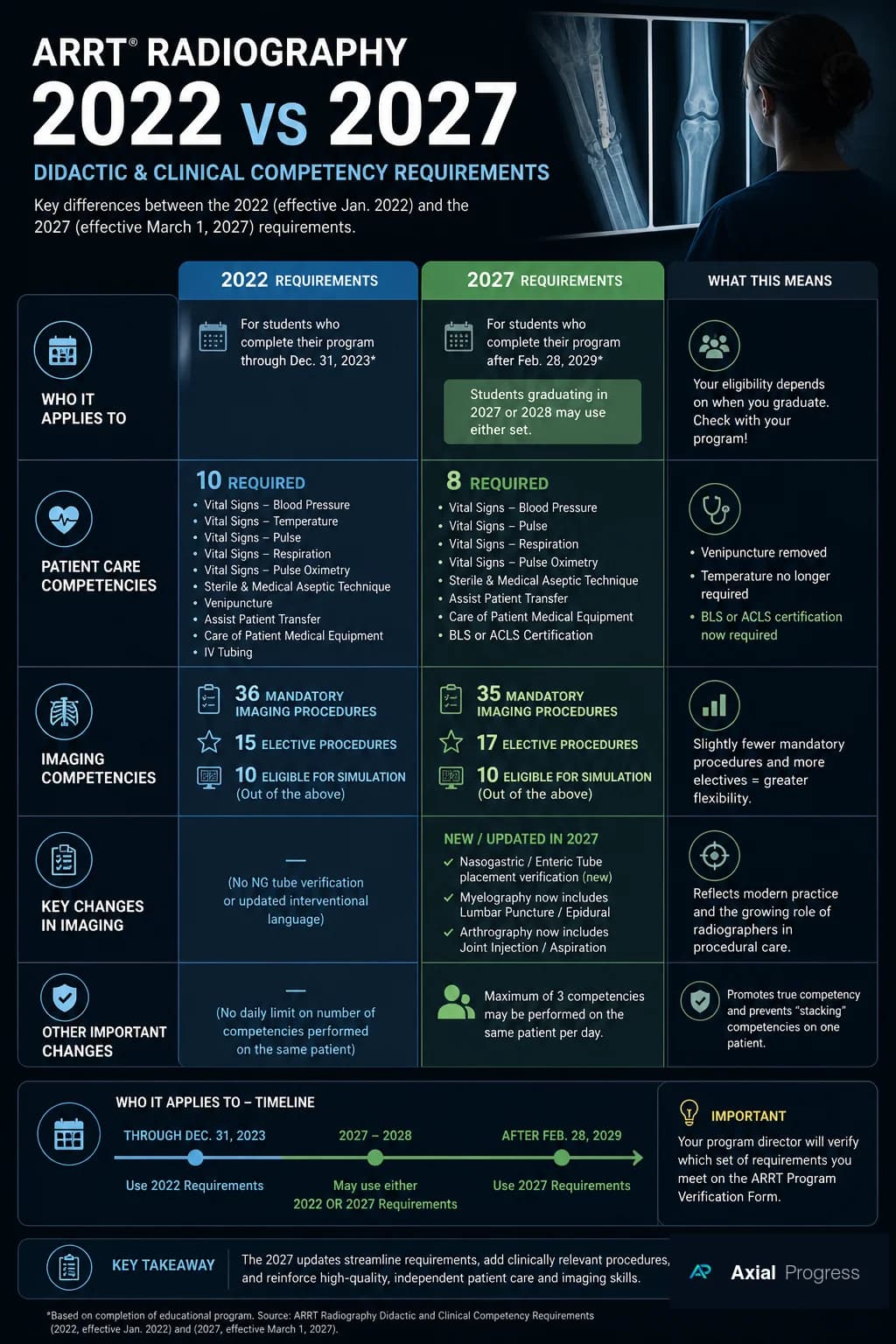
If you're a student, clinical instructor, or program director, you've probably heard that the ARRT updated the Radiography Didactic and Clinical Competency Requirements. The natural next question is: what actually changed?
Here's a practical breakdown — who it applies to, what's different, and why it matters.
First: who do these changes apply to?
The new requirements aren't retroactive. They depend on when a student graduates.
- 2022 requirements apply to students graduating before the 2027–2028 transition window.
- 2027 requirements apply to students graduating after February 28, 2029.
- Transition period: students graduating in 2027 or 2028 can choose either set.
Bottom line: programs need to start preparing now, but students currently enrolled may still be tracking under the 2022 standards.
The big picture
The changes fall into three buckets:
- Fewer but more focused patient care competencies
- A small restructuring of imaging requirements
- Modernization of procedures and terminology
Below is what each of those looks like.
1. Patient care requirements got simpler
2022: 10 patient care competencies, including a full vital signs set (BP, temperature, pulse, respirations, pulse ox) and venipuncture.
2027: 8 patient care competencies. Venipuncture is removed. Temperature is no longer explicitly listed. BLS or ACLS certification is now required.
Why this matters: it reflects how patient care responsibilities vary by state (venipuncture rules in California versus other states are a good example), and it shifts the focus toward core patient safety, mobility, and monitoring.
2. Imaging competencies — subtle, but worth noting
| Category | 2022 | 2027 |
|---|---|---|
| Mandatory imaging | 36 | 35 |
| Electives | 15 | 17 |
| Simulations allowed | 10 | 10 |
Slightly fewer required core exams. A little more flexibility on the elective side. The simulation cap stays the same.
3. Procedures got modernized
The most meaningful change is what was added or redefined.
New in 2027:
- Nasogastric / enteric tube placement verification — better aligned with inpatient workflow.
- Expanded interventional language in fluoro: myelography now includes lumbar puncture and epidural; arthrography now includes joint injection and aspiration.
This reflects the increasing role of radiography in procedural and interventional care.
4. A new structural rule
The 2027 update introduces a maximum of three competencies per day on the same patient.
This is a bigger deal than it sounds. It's a deliberate move away from "comp stacking" and toward demonstrating real, repeatable competency over time instead of checkbox behavior on a busy clinical day.
5. What didn't change
Some core principles are unchanged:
- Procedures must still be performed independently, consistently, and effectively.
- Patient ID verification, positioning, radiation safety, and image evaluation are still required for every comp.
- The simulation limit of 10 exams stays the same.
Translation: ARRT is still emphasizing real clinical competence — not just exposure.
What this means for you
If you're a student: slightly more flexibility in your comp list, less emphasis on procedures like venipuncture (depending on your program), and the same expectation to perform at a high clinical level.
If you're a clinical instructor: expect less checklist chasing and more focus on quality over quantity. Be aware of the three-comps-per-day-per-patient rule.
If you run a program: you'll need to update your competency tracking, adjust clinical expectations to match the new structure, and make sure preceptors understand what changed (especially the per-patient cap).
Where AxialProgress fits
We build AxialProgress as a free competency tracker for RT students, so this change matters to us directly. A good tracker should make it obvious which version of the requirements you're on, count comps the way ARRT counts them (including the new per-patient daily cap), and never let you accidentally over-stack a clinical day.
That's the bar we're working toward. If you're a student or instructor and you've spotted something in the 2027 update we should handle differently, tell us — we'd rather hear it now than ship it wrong.
The takeaway
This update isn't about making radiography easier. It's about making competency requirements more realistic and clinically relevant. The direction is clear: more flexibility in training, better alignment with modern imaging practice, and a stronger emphasis on what "competent" actually means at the bedside.
This post summarizes our reading of the 2027 ARRT Radiography Didactic and Clinical Competency Requirements. Always cross-check specific dates and counts against the official ARRT documentation before making program decisions.